

The medical debt crisis is a rare unifying issue for voters. States have a critical opportunity to mitigate the harms of medical debt while laying the groundwork for systemic, long-term change that reorients our healthcare financing system towards affordable, comprehensive, and accessible care—rather than a system that punishes people for getting sick. Voters across the political spectrum want action, and state lawmakers have a clear opening to respond with policies that have overwhelming public support. This brief is part of a series taking a deeper dive into some of those policies—just how much support do they have, and where have they been put into practice?
Policy Focus: Using a Uniform Application for Hospital Financial Assistance
The problem.
Hospital financial assistance can provide timely, much-needed relief for uninsured and underinsured patients. But while most hospitals offer some form of financial assistance, these programs are under-utilized by eligible patients. Reasons for this vary. Some patients simply do not find out about financial assistance. 1 Others may start the process but become overwhelmed as they struggle to recuperate from a hospitalization or injury. For others, the application forms themselves can be a barrier if they are too complex, too long, or ask for information that seems irrelevant or even invasive to patients. And many patients, especially people with moderate incomes or insurance, do not think financial assistance applies to them.
Federal law requires nonprofit hospitals—around 60 percent of hospitals in the United States2—to post information about their financial assistance policies. But it is silent on where hospitals should set eligibility criteria and how they determineeligibility, including application processes. While many states have set additional parameters for hospital financial assistance programs, only a handful have issued additional guidance about application procedures. Having a uniform approach to hospital financial assistance applications may simplify things for hospitals and patients by making it easier for patients and their helpers to navigate the otherwise byzantine maze of medical billing to find relief, especially in the wake of a health crisis.
Strong, bipartisan support for requiring a uniform application.
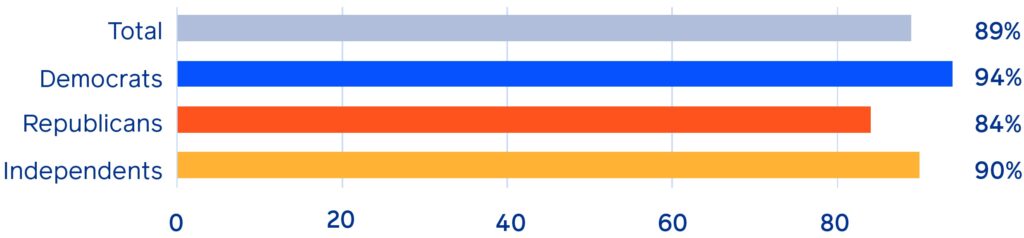
In a series of focus groups and a national survey conducted last fall with voters across the political spectrum, 89 percent of voters supported requiring hospitals to use the same, user-friendly application for financial assistance.3
Require all hospitals to use the same, user-friendly application for financial assistance.
State approaches.
Currently, only two states, Maryland and New York, require all hospitals to use a uniform application for FAP.4 These numbers may change as more legislatures include uniform applications as part of suite of policies to address medical debt (see, for example, bills introduced recently in Massachusetts and Pennsylvania). More flexible approaches are also possible. Recently, Maine passed a law requiring the state department of Health and Human Services to develop an application that hospitals may use, and Connecticut passed a law requiring the Office of the Healthcare Advocate to create an online portal that patients and families can use to get information about hospital financial assistance. Illinois and Washington do not have a mandatory application form for hospitals, but both states limit what questions hospitals can ask to determine eligibility. To help them comply with the spirit and letter of these requirements, the Washington Hospital Association developed application forms and approaches that most of its hospitals have since adopted.
Additional considerations
In addition to wanting hospitals to use the same application form for financial assistance, voters want applications to be “user-friendly.” For state policymakers considering this approach, here are a few considerations to ensure they are simple to use and easy to access for hospitals and patients alike:
- Keep it simple. The application for FAP should be a simple form that is easy for hospitals to administer and for patients to complete. Hospitals should only ask for information that is absolutely necessary to determine a patient’s ability to pay and eligibility for their policy—nothing more, nothing less. If there is a compelling reason to ask for information beyond what is required for eligibility, it should be clear to applicants that providing this information is optional. This application for Ohio’s Hospital Care Assurance Program, which is not required but is recommended by both the state’s Medicaid office and the Ohio Hospital Association, is a great example of a simple, minimalist form.
- Make the application and supporting materials available in languages spoken by the community. Patients should be able to access and complete the application form, and all financial assistance materials, in their primary languages. Federal law requires nonprofit hospitals to have these materials translated into the languages spoken by 1,000 patients or 5% of the community served, whichever number is lower.
- Ensure applications are easy to find. Federal law requires nonprofit hospitals to post their financial assistance policies, application forms, and plain language summaries on their websites. Other states—including Louisiana and Texas—also have state requirements for hospitals to post their policies on their own websites. Patients should be able to access the application on the hospital’s website with minimal clicks from a cell phone or computer. To increase transparency and access, it may also be helpful for states to gather information about all hospitals’ policies in one location, creating a portal where patients can search for information and directly link to each application form. For example, California and Maryland have a one-stop shop for hospital policies; California’s is searchable by county and zip code. Relatedly, Washington’s attorney general maintains a website that helps patients calculate their eligibility for financial assistance and links them to lists of hospitals in the state. Policymakers can also promote the use of consumer-friendly, purpose-built search engines that function similarly. For example, this website from Dollar For, a national nonprofit, helps patients quickly calculate their eligibility for hospital policies across the United States.
- Seek and use input from a variety of stakeholders. Hospitals and patients both have a vested interest in making financial assistance a less cumbersome process. But their insights and constraints are different. To ensure that forms are as user-friendly as possible, state policymakers can include language that requires the development of a uniform application form in consultation with these partners. Using a consultative approach with various stakeholders, and testing various methods, can help users—patients and hospitals alike—develop a form that gets the job done with as little headache as possible.
- For example, a Spring 2024 survey found that 25% of cancer patients and survivors never learned about financial assistance. Survivor Views: Majority of Cancer Patients & Survivors Have or Expect to Have Medical Debt. American Cancer Society Cancer Action Network (May 9, 2024). Accessed February 13, 2026. ↩︎
- “Hospitals by Ownership Type: 2024.” KFF. Accessed February 13, 2026. ↩︎
- Voters Show Strong Bipartisan Support for Policies that Protect People from Medical Debt. Undue Medical Debt (October 2025). Accessed February 13, 2026. ↩︎
- Note that the state laws that required hospitals to use uniform applications for indigent care programs in Colorado and Idaho were repealed after publication due to larger changes in those states’ health care systems—not issues with the uniform applications, per se. See Preventing Medical Debt: State Laws Requiring a Uniform Application for Financial Assistance. Network for Public Health Law (Laws effective as of March 2025). Accessed February 18, 2026. ↩︎