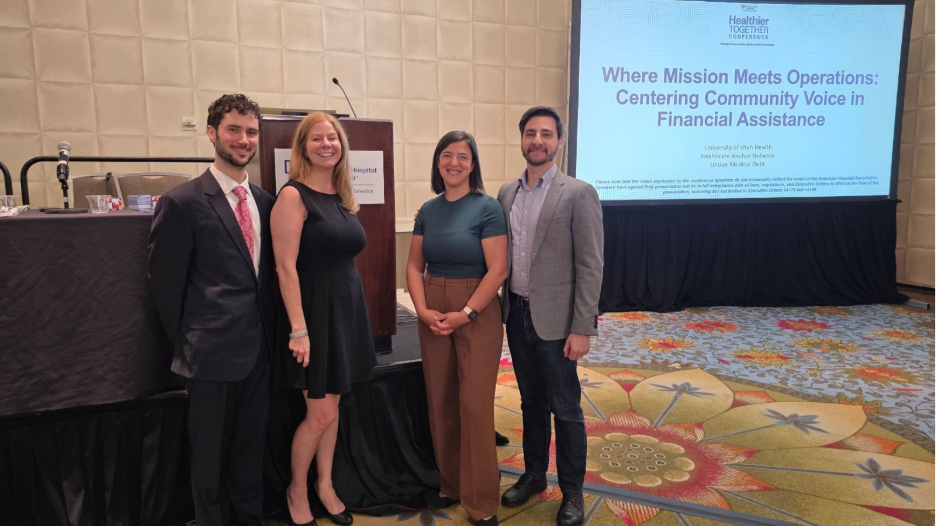

In May, Undue Medical Debt and colleagues from Healthcare Anchor Network (HAN) and University of Utah Health presented on a panel at the American Hospital Association’s Healthier Together Conference in Dallas, Texas. The conference brought together upwards of 600 leaders from hospitals, health systems, public health departments and community-based organizations to share strategies for reducing health outcome disparities and building stronger community partnerships.
Our panel, “Where Mission Meets Operations – Centering Community Voice in Financial Assistance,” shared key learnings from HAN and Undue’s Mind the Gap Learning Cohort and subsequent Journey Map Tool, focused on bridging the gap between hospital revenue cycle and community benefit teams — two departments that are often siloed despite working toward the shared goal of patient wellbeing. At the center of the presentation was a case study from University of Utah Health, a cohort participant.
Read more about the panel, the cohort and how to join the future learning cohort below.
The Problem: Organizational Silos
Inside most health systems, revenue cycle and community benefit teams share a common purpose: improving the health and financial wellbeing of the patients they serve. Yet in practice, these departments often operate in separate silos with different reporting structures, data systems, and jargon, along with limited day-to-day collaboration. This often amounts to little more than an annual update on financial assistance expenditures to complete Section H of the hospital 990.
Revenue cycle teams manage the complex financial machinery of healthcare: coding, billing, insurance verification, prior authorization, claim denials and patient financial assistance. Community benefit teams focus on population health, health needs assessments and addressing the social and economic factors that drive health outcomes. Both are essential, but the gap between them has real consequences for patients. Our panel set out to name that gap and chart a path toward closing it.
THe Mind the gap initiative
This panel presentation at the Healthier Together Conference grew out of the Mind the Gap learning cohort: a collaboration between HAN and Undue that brought together health system revenue cycle and community benefit leaders for a year-long collaborative focused on exactly this work. Participating teams built new connections, developed shared language, improved cross-team data access and identified concrete strategies to help patients avoid medical debt. University of Utah Health was among those putting these lessons into practice, offering a real-world example of what it looks like to move from insight to action.
Learn more about the Mind the Gap tools and cohort HERE.
Panel Presentation – The Power of Cross-Sector Collaboration
Our presentation highlighted the combination of HAN’s expertise in systems-change and anchor mission movement building with Undue’s health policy analysis and medical debt expertise. Participants also heard a case study on how University of Utah worked across teams to enhance the inclusivity of their financial assistance policy.
The key learnings from the Mind the Gap cohort include:
- Understanding one another’s roles and the language they use matters.
- Data sharing is underutilized.
- Community benefit staff may not deeply understand how financial assistance is operationalized.
- Revenue cycle staff need additional support in advancing patient-centered solutions.
- Internal allies are important stakeholders, and broader relationship-building is vital to implementing change.
- Change happens, and how we navigate it is key.
To illustrate these learnings in practice, University of Utah Health brought the practitioner’s perspective. RyLee Curtis, Senior Director of Community Collaborations, presented on how her community engagement team collaborated with colleagues from Revenue Cycle and Patient Experience to create a feedback loop incorporating community input on existing financial assistance policies. They paid particular attention to helping community members who may face barriers, concerns or uncertainty when accessing healthcare services safely and confidently.
RyLee’s experience demonstrated what is possible when institutional will, data sharing and interdepartmental trust are built over time, and how those connections translate into tangible improvements in patient experience and outcomes.
What we heard in the room
The engagement from conference participants was remarkable. Audience members — directors, vice presidents and senior leaders from health systems across more than 20 states — came ready to engage, and their questions made it clear that this conversation resonates far beyond any single organization. Many recognized the silos we described in their own institutions and were looking for practical first steps. While every health system is different, a recurring theme was interest in taking those initial steps toward connecting community benefit and revenue cycle to enhance patient experience and outcomes.
Looking ahead
Undue Medical Debt sees debt relief as an impactful intervention, not a long-term solution to healthcare affordability. We are deeply committed to addressing the systemic roots of the medical debt crisis through public policy and hospital practice change — work that starts upstream, inside hospital walls and in the collaboration between teams that talk to each other too rarely.
The work of connecting mission to operations — ensuring a health system’s values are reflected in the day-to-day decisions of every department — is ongoing. It requires leadership commitment, cross-functional trust and a willingness to look honestly at where the current system falls short.
Keep an eye out for more updates from the Mind the Gap cohort as we launch our application for the second cohort of HAN Health System partners.
Interested in more information about the next cohort? Contact Carol Gaudino at [email protected].